Blog
Denied Is Not the Diagnosis
Behavioral Health Is Producing Predictable, Preventable Denials at Scale. The Fix Starts with Treating Documentation as Clinical Advocacy.
By Felicia Morris, AS, BS, LADAC II, CADC II, CPRS, CRCR

Blog
Behavioral Health Is Producing Predictable, Preventable Denials at Scale. The Fix Starts with Treating Documentation as Clinical Advocacy.
By Felicia Morris, AS, BS, LADAC II, CADC II, CPRS, CRCR
A behavioral health clinician, former patient, and revenue cycle professional reframes documentation as a form of patient advocacy, and closing the gap between clinical reality and payer language as where parity for behavioral health is actually won.
In this piece, you’ll learn:
About the author
 Felicia Morris, AS, BS, LADAC II, CADC II, CPRS, CRCR, is a behavioral health clinician with lived experience in long term recovery and a background spanning medical necessity, authorization defense, and utilization review, including work as a former peer-to-peer reviewer across multi-state networks. She currently serves as a Project Manager at Hansei Solutions, a behavioral health revenue cycle management company, where her clinical background informs compliance, AI product development, and workforce training at a national scale. She developed and presents the training Denied Is Not the Diagnosis: Advocacy and Access in Behavioral Health Treatment Through Authorizations and Appeals at regional conferences.
I went to treatment fourteen times before recovery finally took.
If any of the authorizations during that fourteenth stay had been denied, I don’t think I would be alive to write this. Tha’s not rhetoric. Somewhere in that history, my therapist wrote a note good enough to earn me an extended authorization for six weeks of residential substance use treatment on a Medicaid plan. And a utilization reviewer I never met defended my medical necessity to a payer. I never learned that reviewer’s name.
Their advocacy is part of why I am in long-term recovery today.
I share that because it is the foundation of every argument in this article. I am a behavioral health clinician with credentials in addiction counseling, peer recovery support, and revenue cycle. I also work behind the scenes in revenue cycle management at Hansei Solutions, where I see authorization and denial patterns across dozens of states. That combination of clinical knowledge, lived experience, and a national view of how denials actually happen has shown me something I think the field needs to hear more directly.
We are producing preventable denials at a predictable rate. The root cause isn’t just payer obstruction. It is a documentation problem. More precisely, it is a training problem. We send clinicians into a system whose real audience is an insurance reviewer, and nobody ever tells them that.
The Pattern Hiding in the Denials
When a payer denies a continued stay or steps a patient down, most facilities take it personally. The patient is not sick enough. Not trying hard enough. Does not meet criteria. We absorb it. We move on to the next fire.
But the reviewer who made that call has never met the patient. Never will. They are not evaluating a human being. They are evaluating a chart. The denial is a verdict on the documentation, and what I see from the revenue cycle side, consistently, across states and payer types and facility sizes, is this: the same documentation failures produce the same denials. Over and over. They are not random. They are predictable. And if they are predictable, they are preventable.
Consider two clinical notes. Same patient. Same day. Same clinical reality.
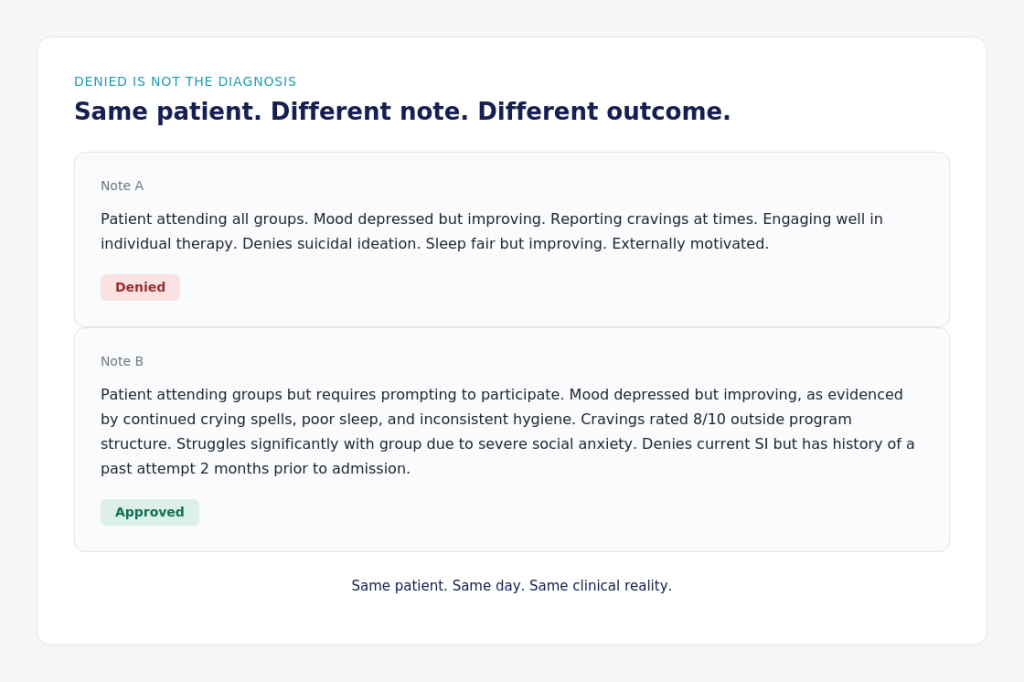
Nothing was invented. Nothing was exaggerated. The second note told the whole story. The first told a version that gave the reviewer no clinical basis to approve additional days. That is not a documentation tip. That is how patients lose access to care.
How Clinicians Unknowingly Build the Case for Denial
One of the most consistent patterns I see in denials is language that frames expected symptoms as patient failures. We admit someone with oppositional defiant disorder, intermittent explosive disorder, or severe social anxiety, and then we describe their symptoms as though those symptoms are the problem. As though the diagnosis is not the reason they are in our care.
A patient dysregulates, and the note says “combative.” A patient with severe social anxiety does not participate in group, and the note says “noncompliant.” Someone displaying the textbook expected symptoms of their diagnosis gets labeled “treatment resistant.” Look at the DSM-5-TR criteria for any of those disorders. The behaviors the note calls “failures” are in the diagnostic criteria.
Resistance is not proof that treatment failed. For many of these diagnoses, resistance is the illness.
A reviewer reads those labels exactly as they sound. Not participating. Not progressing. No need to continue care. Each one, read from the payer’s side, becomes ammunition. Evidence that the patient does not need the level of care they are receiving. We have built a system where the sicker a patient presents on paper, the easier they become to deny.
And the fix isn’t complicated. It is specific and teachable. Document symptoms as symptoms, with observable evidence, to defend medical necessity. “Impaired impulse control” gets denied. “Impaired impulse control as evidenced by recent relapse despite stated goals, previous AMA discharge, and engaging in behaviors including driving under the influence” gets approved. “Patient is depressed” is a conclusion. “Depression as evidenced by decreased appetite with one meal per day, sleeping 3 to 4 hours per night, crying spells, and social withdrawal from peers and programming” is a clinical picture a reviewer can act on.
The difference between a denial and an approval often comes down to three words: as evidenced by.
What Actually Happens When the Authorization Gets Denied
Here is what doesn’t get talked about enough: what happens on the other end of that denial.
When a continued stay authorization is denied, the patient’s treatment is interrupted. Sometimes they are stepped down to a level of care that is not sufficient for their acuity. Sometimes they are discharged outright. Either way, the continuity of their care has been broken, and for patients in early recovery from substance use disorder, that interruption can be catastrophic. Relapse rates spike in the first hours and days after leaving a structured environment. We know this. The research is unambiguous.
But it goes further than clinical destabilization.
When an authorization is denied, and the patient has already received care, someone has to pay for the days that were not approved. If the facility cannot successfully appeal, that cost falls on the facility or the patient. And it does fall on patients. People in the first weeks of recovery, still fragile, still finding their footing, get hit with bills for thousands of dollars. Sometimes tens of thousands. For care they already received. For days a clinician believed were medically necessary but couldn’t prove in the language the system required.
Try to imagine what that does to someone’s recovery. You are thirty days sober for the first time in years. You are trying to figure out housing, employment, and reconnecting with your family. And a bill arrives that you will never be able to pay. That kind of financial crisis in early recovery is not an inconvenience. It is a destabilizer. It is the kind of thing that sends people back out. And we act surprised when it does.
Denied authorizations are not just an administrative outcome. They are a clinical event with clinical consequences. When we treat them as paperwork, we miss that a patient’s stability, length of stay, and shot at sustained recovery all depend on whether someone documented care in a way the system could approve.
The Impossible Window and the Role of Dimension 6
Here is a trap most clinicians do not know they are standing in.
Document insufficient progress, and the payer denies for lack of medical necessity. Document strong progress, and the payer denies because the patient no longer meets criteria. Document regression, and the payer pushes the patient toward a higher level of care even if that placement is not actually reachable for them.
That last one is worth sitting with, because a protection against it already exists. Most clinicians have just never been taught it’s there.
The ASAM Criteria 4th Edition scores Dimensions 1 through 5 to establish severity and risk. Dimension 6 is different. It’s deliberately unscored, and asking a simpler question: does this patient actually have the ability and willingness to engage in the level of care being recommended? Not on paper. In their real life.
A single parent with no childcare cannot walk into residential treatment. A patient with no car cannot get to a daily PHP or IOP. Someone who missed one shift from losing their job cannot risk the time off. None of that makes them less sick; it just makes the “correct” level of care unreachable. And treatment they can actually get to is better than treatment they can’t.
So when a payer pushes toward a level of care Dimension 6 says they can’t access, that’s not a higher standard. That’s the payer ignoring the exact protection ASAM built to prevent this.
Which is why documentation matters here. A clinician who knows Dimension 6 exists can name the barrier in the chart and hand the reviewer a clinical reason to authorize the placement in front of them. A clinician never trained in ASAM’s framework has no way to defend a patient against a standard they don’t know they’re being held to.
A Parity Problem in Plain Sight
Behavioral health admissions face more frequent concurrent reviews, more pressure to step down after fixed timeframes, and a heavier justification burden than comparable medical or surgical admissions. That is not opinion. It is documented enough that Congress passed the Mental Health Parity and Addiction Equity Act (MHPAEA) to address it. The law requires that utilization management for behavioral health be no more restrictive than for medical and surgical care.
So let me put this plainly. If a patient has a heart attack, undergoes surgery, and develops a complication, nobody discharges them on day three because “that’s what the guideline says.” They stay until they’re stable. The guideline is a reference point, not a clock.
Substance use treatment doesn’t get that courtesy. A patient can be actively symptomatic, clinically unstable by every measurable standard, and still get pushed toward step-down because the length of stay guideline says they should have left two days ago. That’s a nonclinical limit dressed up as a clinical determination which is exactly the kind of nonquantitative treatment limitation MHPAEA was designed to prohibit.
Patients pay for it in premature discharges and the readmission cycles that follow. We call it chronic relapse. We call it treatment resistance. We rarely call it what it often is: a system that cut care short and then blamed the patient for the predictable result. Relapse is an expected feature of substance use disorder; it is evidence the patient still needs access to care, not proof that treatment failed. When documentation frames it as patient failure, it hands payers clinical sounding language to justify what is, at its core, a nonclinical limit.
The Part Nobody Wants to Say Out Loud
I want to be honest about something. Everything I’ve described so far puts enormous weight on the clinician: to write better notes, learn payer logic, master ASAM, defend every authorization. And clinicians are already drowning. The field’s staffing crisis shows no sign of easing. Caseloads are unmanageable, turnover is relentless, and clinicians are already skipping their own documentation just to handle the next crisis. Asking them to also become experts in utilization management sounds, from the inside, like one more impossible expectation from someone who doesn’t know what their day looks like.
I hear that. I’m not dismissing it. But stay with me, because this is the part that changes the math.
When documentation feels administrative, it’s the first thing that gets deprioritized. Of course it does. Charting becomes something you do at the end of the day, if there’s time. Except it isn’t administrative. It’s the mechanism that decides whether your patient keeps their bed, whether their family gets a bill they can’t pay, whether the person you just spent an hour with gets three more days to stabilize.
I’m not asking clinicians to work harder. I know most couldn’t if they tried. I’m asking them to see documentation differently: not a compliance checkbox competing with patient care, but one of the most direct forms of patient advocacy they provide. That doesn’t lighten the workload. It changes what gets prioritized, and why.
And this isn’t on clinicians. The systems that trained them never taught this. The facilities that employ them don’t staff for it. We’re asking clinicians to do the most important advocacy work of their day with the least support and the least training. That’s an industry failure, not an individual one.
Documentation as Clinical Competency
The behavioral health field treats documentation training as an administrative concern. Clinicians learn to chart for compliance, for audit readiness, for legal protection. They are rarely taught that the note is a clinical tool whose primary external function is to justify continued access to care for a patient who cannot advocate for themselves in that process.
This is not a secondary skill. It is a clinical competency. Every peer-to-peer review, every appeal filed, every denial overturned is a direct intervention in the continuity of someone’s care. When we train clinicians to treat people but never train them to defend that treatment in the language the system requires, we leave one of the most powerful forms of patient advocacy on the table.
Systems literacy belongs in clinical education. Authorization strategy. Appeal structures. Payer behavior. ASAM Criteria documentation. Medical necessity language. Clinicians should learn these alongside therapeutic modalities, not as something they figure out on the job or, more often, never learn at all. Documentation is where clinical knowledge meets the system that decides whether a patient stays in care or gets sent home. That intersection is the front line of patient advocacy, and we have left it largely undefended.
A Denial Is Not a Diagnosis
Every symptom a clinician names as a symptom, not a character flaw, is a day of care defended. Every “as evidenced by” that shows the clinical picture instead of stating a conclusion is a patient who keeps their bed. The pattern I see nationally is consistent. It is not random. It is the predictable output of a system that turns nonclinical decisions into clinical sounding language, and then blames patients when the outcomes are bad.
If you work in clinical care, utilization review, clinical leadership, or education, the call to action is simple. Treat documentation as what it is. Not compliance. Not overhead. Not the thing that waits until the end of the day. Clinical advocacy. Write like your patient’s life could depend on it, because it just might.
A denial is not a diagnosis. The field needs to stop treating it like one.
I do this work because someone cared enough to do it for me first. The person who wrote that note never got a thank you card. The reviewer who defended my medical necessity never got an accolade. That is the nature of this work: it happens behind the scenes, and it stays there. I know now, from the other side, that helping people who will never know your name is the most rewarding work I have ever done. If my reviewer from all those years ago happens to be reading this – thank you for saving my life.
References

Ready to focus on providing healthcare? Let us lighten your load.
We’re here to address your pain points and create growth opportunities for your organization. We’re passionate about what we do, and it shows in every interaction. Learn what makes us tick and schedule a demo today.