Blog

Blog
Medical credentialing plays a critical role in ensuring safe, ethical, and compliant care across the behavioral health field. For treatment centers, therapists, counselors, psychiatrists, and other behavioral health professionals, proper credentialing determines whether they can legally provide services, bill insurance, and participate in payer networks. As reimbursement rules tighten and payers increase oversight, understanding medical credentialing in mental health is essential for financial stability and continuity of care.
At Hansei Solutions, we help mental health and substance use treatment providers navigate the credentialing process to ensure compliance and prevent costly disruptions. Below, we break down how credentialing works, what the process includes, and why it is becoming more important than ever.
Medical credentialing is the process of verifying a provider’s education, training, licenses, certifications, and professional experience to ensure they are qualified to deliver clinical care. Insurance companies, regulatory agencies, and healthcare organizations require credentialing to:
In mental health treatment, credentialing applies to:
Without credentialing, providers cannot bill insurance—and treatment centers risk significant compliance and reimbursement issues.
Credentialing is especially important in behavioral health because of the sensitive nature of mental health treatment and the variability in provider licensure regulations across different states.
According to the U.S. Department of Health and Human Services (HHS), credentialing is one of the primary safeguards used to maintain quality and safety in healthcare delivery systems.
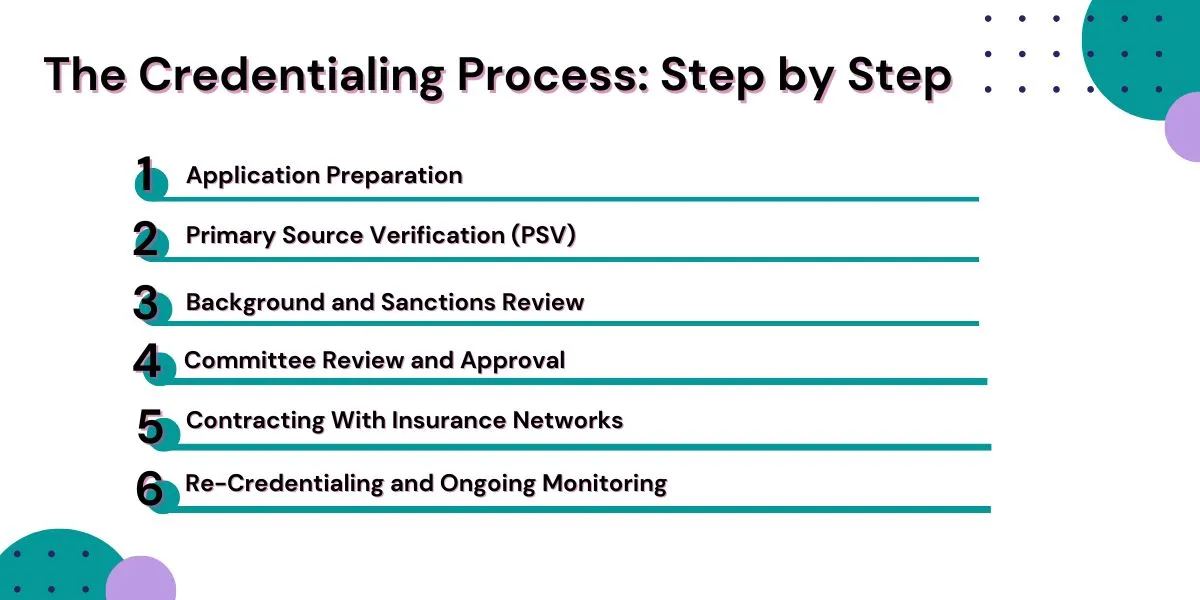
Credentialing involves several detailed steps that must be completed accurately to avoid delays. These steps vary slightly by payer but generally follow the same structure.
The provider submits all required documents, which often include:
Missing or outdated documents are a major cause of credentialing delays.
PSV is the heart of the credentialing process. Insurance companies and credentialing bodies verify the information directly with the issuing institutions.
This includes verification of:
The National Committee for Quality Assurance (NCQA) requires PSV for all credentialed providers, and this process can take several weeks depending on provider history and completeness of documents.
Payers review provider records through federal and state databases such as:
This step ensures providers have no disciplinary actions preventing them from delivering care.
Credentialing committees—at hospitals, treatment centers, or insurance companies—evaluate the verified information and determine whether the provider meets their standards.
Committee review often includes:
Once approved, the provider is credentialed but may still need additional steps to join payer networks.
Credentialing and contracting are separate processes. After credentialing, a provider must sign a contract with the payer to become an in-network, reimbursable provider.
This step includes:
Only after contracting can the provider bill as in-network.
Credentialing isn’t a one-time event. Most payers require re-credentialing every 2–3 years, along with ongoing monitoring for licensure status, disciplinary actions, and compliance.
NCQA and CMS both require organizations to track changes in provider credentials continuously, not just during renewal periods.
Credentialing timelines vary, but most range from 60 to 120 days, depending on:
According to CAQH, U.S. healthcare organizations spend over $2.76 billion annually on credentialing-related administrative work—much of which results from repeated data entry or missing information.
A single mistake can delay network participation for weeks or even months, causing financial strain for treatment centers.
Mental health providers face unique hurdles during the credentialing process:
This is why many treatment centers partner with credentialing experts to manage the process effectively.
Credentialing issues create major financial challenges for behavioral health providers. At Hansei Solutions, we support credentialing by helping providers:
With payers tightening oversight, strong credentialing workflows are essential to prevent denials, reduce administrative burden, and support long-term sustainability.
Credentialing directly impacts:
Uncredentialed or incorrectly credentialed providers put treatment centers at risk for:
Credentialing is not just paperwork—it’s the foundation of safe, ethical, and financially sustainable mental healthcare.
Credentialing ensures a provider is qualified, licensed, and authorized to deliver care and bill insurance. It protects patients, providers, and treatment centers by maintaining clinical and regulatory standards.
Most credentialing processes take between 60 and 120 days, depending on payer response times and the completeness of documentation.
No. Credentialing verifies qualifications, while contracting establishes the provider’s reimbursement rates and in-network status.
Claims may deny, and the treatment center may face compliance risks or recoupments. Providers may also be unable to see certain patients.
Yes. Hansei supports credentialing preparation, documentation, monitoring, and payer-specific navigation as part of our comprehensive revenue cycle services.
Whether you’re onboarding new clinicians or navigating payer network requirements, credentialing doesn’t have to slow your organization down. At Hansei Solutions, we help behavioral health providers take control of their credentialing workflow so they can focus on delivering high-quality care. Talk to Hansei Solutions about improving your credentialing process.

Ready to focus on providing healthcare? Let us lighten your load.
We’re here to address your pain points and create growth opportunities for your organization. We’re passionate about what we do, and it shows in every interaction. Learn what makes us tick and schedule a demo today.